Friday, 25 March 2016

The ultimate lunch box:

 tiffin

I mentioned in “Tiffin time” that tiffin is also a midday meal and in particular a portable lunch.

These boxes are usually round and have three/four separate compartments with a lid and clips to secure, to prevent spillage of the contents and a handle.

In Mumbai, India (and in other areas there too) a dabbawala (literal translation “one who carries a box”) is a person who is an integral part of a delivery system of food to workers – collecting from the workers' homes in the morning in time to deliver at the place of work by lunchtime and then return the lunch box to the home for use the next day. The boxes are taken by bike and then on to trains, picked up from their destination and taken to the appropriate place of work.

Each box has a code – for collection from home – outward railway station – station destination and then a distinguishing mark for the receiving dabbawala at the place of work enabling delivery, i.e. to the appropriate building and floor.

Lots of office workers prefer to eat food from home. There are obviously restaurants and also street food stalls, but clearly the tiffin box has remained popular - this service first appeared in the 1890ies and has grown and grown – research says that between 175,000 and 200,000 tiffin boxes are moved every day.

Thought you might like to see what they look like :


Fast food – there's fast and then there's fast!


Saturday, 19 March 2016

Last call for Easter: …Tiffin time!

The yummiest of biscuit type treats, this snack is so easy to make, doubly perfect because it requires no baking - another possible candidate for the kids to make during the Easter holidays.

The jury appears to be out as to its origin. There's the “tiffin” which began life in India (and still exists today) in the days of the British Raj as a midday meal or luncheon – “tiffin” then went on to describe what we now know as the British custom of afternoon tea. In certain parts of India tiffin is regarded as a snack, in others it is a substantial portable lunch. However, I also discovered that it was invented in the 1900's in Troon, Scotland.

Tiffin

4oz unsalted butter
2 tbsp castor sugar
2 tbsp golden syrup
4 tsp cocoa
8oz digestive biscuits, crushed finely
(or Rich Tea if you prefer)
Handful of raisins
or, if in a festive mood - cranberries
8oz chocolate
(you can mix 4oz milk, 4oz plain)

Melt the butter, sugar, syrup and cocoa.

Add the biscuits and raisins, stir to combine. Pour into a Swiss roll tin or into foil trays to suit your purpose, press down firmly.

Melt the chocolate – either in the microwave or in a bowl over simmering water (as always being careful not to let the bowl touch the water). Pour the chocolate over the mixture . Put into the fridge and leave to set for an hour.

Makes approximately 20 pieces.

A voyage of discovery – whether Indian or Scottish it's as old as the hills and delicious either way.

Happy Easter!


Last call for Easter: …bag, tag, bow and away you go!

If you've received feedback from circulating your list with any luck you'll get more than one person choosing the same ingredients!

I'd use a tray bake, measuring 30 x 19 cms approx. One tray bake divided into four portions and then each portion cut into small 1cm squares will give a generous treat.

Take a glance at the photo of the Rocky Road in Last call … to get an idea of the size. To give perspective, Nigella's recipe mentions 24 squares of treat in the final paragraph – these are large, so scaled down you'll get a much larger quantity, it depends on how small a square you cut. It doesn't matter – I don't think anyone will be taking out their tape measure!

One final thought, you could mix it up completely and create a mixed bag of Rocky Road, Malteser Cake and Chocolate Hokey Pokey.

Malteser Cake

125g unsalted butter
400g milk chocolate, broken into small pieces
2 tbsp golden syrup
250g digestives - crushed
135g Maltesers

Line a 20cm tin with parchment.

Melt the butter in a large pan, then add the chocolate and syrup until melted.

Remove the pan from the heat, allow to cool slightly then stir in the biscuits and Maltesers. Pour into the tin and refrigerate for two hours.

Cut into squares.

Chocolate Hokey-Pokey

75g unsalted butter
100g pecan halves, roughly chopped
sea salt flakes
300g dark chocolate
2 tbsp golden syrup
3 x 40g Crunchie bars

Heat a small knob of butter in a pan and when foaming, tip in the pecans with a pinch of sea salt flakes. Stir over a medium heat for 3-4 minutes or till toasted – you will smell them when they are ready. Tip the nuts into a bowl and leave to cool.

Break the chocolate into small pieces and melt, in a medium pan, with the rest of the butter and the syrup, stirring. Once the chocolate mixture is smooth, take the pan off the heat. Bash the Crunchie bars (in the wrappers – less messy!). Add the Crunchie pieces, along with the toasted pecans, to the chocolate mixture. Gently mix together before transferring to an 18cm round or square foil tray (or cake tin if you prefer to wash-up!)

Leave to set in the fridge. Once set, remove from the tray and cut into 1cm squares.

Whatever combination you choose bag, tag and bow – check out The kit and the cost – and away you go!


Last call for Easter: …your version

So, my final Easter treat idea is design your own “Rocky Road”.
I circulated a list and asked for three choices – not giving the game away of course.

Here it is :
Peanut
Pistachio
Pecan
Hazelnut

Glace cherry
Dried sour cherries
Cranberry
Apricot
Banana chips
Pineapple
Sultanas

**Nougat
**Turkish Delight
**Fudge
**Toblerone
**Praline
**Salted Caramel
Mini Marshmallow
Popping Candy – you can even get
chocolate coated popping candy


Those choices marked ** should be cut into 1cm (ish) squares.

This list is not exhaustive – I'm sure you've got plenty of ideas of your own. All you need to do is substitute the three ingredients marked * in the original recipe with those you prefer.

You might be amused and surprised at the feedback – I never knew that my Editor and IT Consultant loathed and detested cherries and that's putting it mildly … “cherries – never. Never, ever, ever. The only thing worse than cherry is artificial cherry and why would anyone make an imitation of something that horrible? We don't know but studies are being done as we speak”.

Yikes!


Last call for Easter: ... chocolate treats that is!

Rocky Road – your version

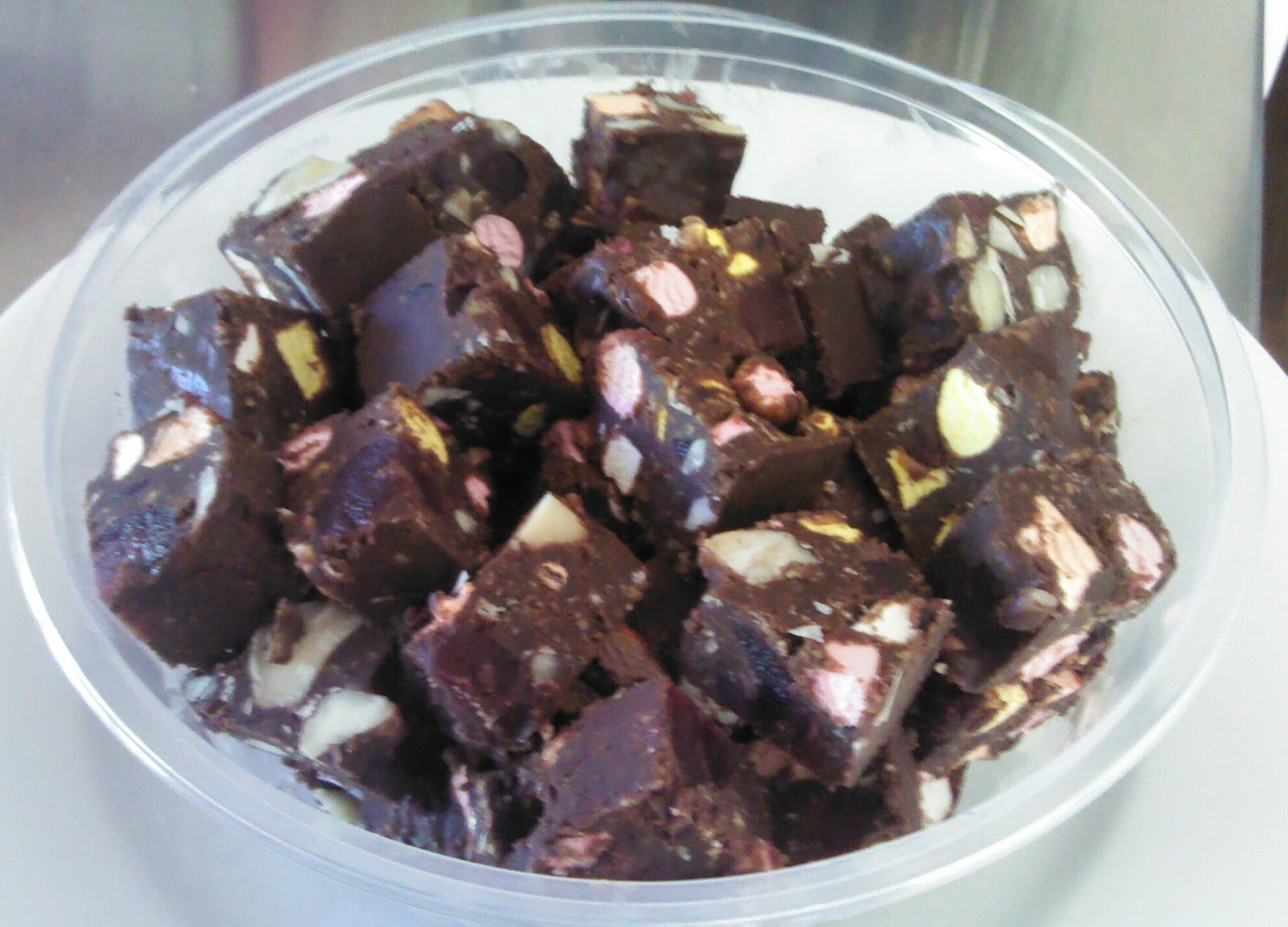
Rocky Road was first mentioned in Outside the box and Outside the box Take II. To refresh your memory, the traditional version looks like this :


You'll see that my version is cut into small bite sized pieces, not the larger squares mentioned below – it's whatever floats your own boat!

Here's the traditional recipe :

Rocky Road

250g dark chocolate
150g milk chocolate
175g soft butter, unsalted
4 x 15ml tbsp golden syrup
200g amaretti biscuits (or hobnobs if you can't get hold of amaretti)


*150g shelled Brazil nuts
*150g red glace cherries
*125g mini marshmallows


Put the biscuits into a freezer bag and bash with a rolling pin to get a mixture of rubble.

Put the Brazil nuts into another freezer bag and bash them too.

Chop both sorts of chocolate into small pieces, or use chocolate buttons made for melting and then put them into a heavy-based saucepan to melt with the butter and syrup over a gentle heat.

Take the pan off the heat and add the biscuit and nuts, cherries and mini marshmallows. Turn carefully so that all the ingredients are coated with the syrupy chocolate.

Tip into a foil try (I use a tray bake size), smoothing the top as best you can, although it is meant to be bumpy.

Refrigerate until firm enough to cut, which will take about 1½-2 hours. Take the set block out of the tray. With the long side in front of you cut 6 slices down and 4 across so that you have 24 squares.

This was taken from “Nigella Christmas” – Christmas Rocky Road


Make ahead tip:

Make the Rocky Road and refrigerate to set, cut into bars and then store in an airtight container in a cool place for up to 1 week.

Freeze ahead tip:

Make the Rocky Road as above and free for up to 1 month. Thaw overnight in a cool place.

It's not everyone's cup of tea – there will always be someone who doesn't like this or that ingredient. Furthermore in these days of serious allergies – nuts for example – you can select whatever suits you and/or family and friends so that everyone can indulge!

Sunday, 13 March 2016

Here goes nothing – or how to segment an orange!

STEP 1

Top and tail your orange so that it's stable.


STEP 2

Using your bread-knife held at an angle and using a gentle sawing motion following the shape of the orange, remove the outer peel.


Continue until all the peel is removed.

STEP 3

Sit the orange in your hand – you can see the segment membranes – they look like fine white lines. Gently slice the left-hand side of your first segment making sure you keep the white line to the left of your knife.


Repeat, slicing the right side of the segment, now keeping the white line to the right of your knife.


  • one perfectly formed segment! Repeat this process until you've segmented the whole orange.


STEP 4

You'll be left with a handful of membranes and pith loaded with fresh juice – squeeze into the container with your segments.


Here's the finished bowl of both!


Enjoy your Master Class!

Thinking cap!

Ice cream on its own doesn't look particularly exciting, even if it is home-made. Whilst the sundae mentioned previously does sound fab it's a little too much of a sweet hit for my personal taste and for that matter, for my guests and friend too.

With that in mind what better to go with a rich chocolate truffle ice cream than oranges – oranges are the best fruit! Surely one of the best marriages, chocolate and orange.

Orange segments are the answer – although creating the perfect one can be a tricky business.

There are three elements you'll need to tackle, the thick outer peel, the white pith on the inside and finally the thin, tough outer membrane of each segment.

Choosing the right type of orange also matters – “naval” fits the bill since it has no pips (or seeds if you like).

You don't need a fancy dancin' posh piece of kit for this chore either – I find that a serrated bread knife is just the job – naturally used CAREFULLY AND SAFELY!

Wear gloves if you are offended by sticky hands from the orange juice. You'll need a container for your segments.

Get yourself organised before you begin. Decide how many oranges you want to divide. As a guide you'll get 10 ish segments per orange – it will vary – at least you'll have an idea, depending on how many guests you're serving.

You can serve the segments as is or, if you are serving adults you can soak them in either Cointreau or Grand Marnier – add 1 tbsp of liqueur to 100mls of additional fresh orange juice per two segmented oranges.

Give a thought to decoration – small amaretti biscuits would meet the brief, as would tuile biscuits – a little added crispy texture.


Have I got your attention?