Showing posts with label Pastry Technique. Show all posts

Friday, 25 July 2025

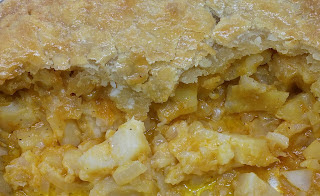
Homity Pie


MiamMiam

School of Cookery


Homity Pie

Serves 12-16 depending on size of slice


Pastry case


200g plain wholemeal flour

100g unsalted butter

pinch of baking powder


ice cold water to bind


Rub the butter into the flour and baking powder until it resembles breadcrumbs, then gradually add a glug of water and use and round bladed knife to bring the pastry together.

You can use a processor to reach the breadcrumb stage if you prefer – I'd then tip the pastry into a mixing bowl and add the water by hand.

Rest the pastry in the fridge for 30 minutes.


Ahead of the game


Bake 6 large jacket potatoes, then cool, peel and dice finely

and place in a large mixing bowl


xxxxxxxxxxxxxxxxx


500g onions, finely chopped

3 cloves garlic – finely chopped or roasted

paste

3 tbsp rapeseed oil

salt and black pepper

5 tbsp of freshly chopped parsley – 3 tbsp for the

filling and 2 for the topping – use less if you are

using dried

300g of grated cheese – I use a mixture of mature

cheddar, Gruyere and Red Leicester – 200g for the

filling and 100g for the topping


Sauté the onion and garlic in the oil, add to the potatoes and season with salt and black pepper. Add the cheese and parsley, mix thoroughly.

Roll out your pastry and line a greased baking dish measuring 24cms in diameter x 5cms deep.

Tip your potato mixture into the pastry case and pack it down tightly and flat – it will look as if you'll never get all the filling into the case – persevere – you will succeed.

Top with the remaining cheese and parsley.

Bake in a pre-heated oven – 190fan/170c/Gas 7 for 40 minutes – check after 20 minutes.


Alternatively you can make mini homity tarts using the same recipe, you'll get 18, 7cm “cases” - based on a bun tin of a similar size . Roll out the pastry and cut out circles using a straight sided 7cm cutter.

I'd recommend passing the potato through a ricer before adding the remaining ingredients. I'd also suggest using an ice cream scoop – measuring 5cms in diameter – to fill the cases. Press the filling down gently to flatten and garnish and bake as per the original recipe.

Whether you're making the large pie or the individual cases you can make them ahead and freeze. Once you've lined the greased baking dish, freeze until required. Once lined, place the bun tin in the fridge for 30 minutes. Remove the tin and ease out the cases, bag and freeze until required.

In the unlikely event that you have any leftover it freezes really well – freeze in individual portions.

Either version of the homity is useful – serve the pie as part of your Boxing Day lunch, or as the centre piece of your buffet. The tarts are a great size for a canapé or serve as a starter warmed with antipasti or garnish with diced chorizo, fried – not forgetting a drizzle of the delicious oil.

By the way ...

Friday, 18 July 2025

Here's another example ...

of a “pie” without a pastry lid.

I cannot speak highly enough of Homity Pie - I normally make it for special occasions and to give you an idea of how popular it is – my recipe serves 12-16 depending on the size of slice!

The following recipe is a smaller version - I decided to make the same amount of pastry but scale down the filling – I freeze the remainder for another day – here goes :


Homity Pie – makes 2 pies


Pastry


200g plain wholemeal flour

100g unsalted butter

pinch of baking powder


ice cold water to bind


Rub the butter into the flour and baking powder until it resembles breadcrumbs, then gradually add a glug of water and use and round bladed knife to bring the pastry together.

You can use a processor if you prefer – I'd then tip the pastry directly onto clingfilm and bring it together to form a ball, then wrap and rest it in the fridge for 30 minutes.


Ahead of the game


Bake 3 large jacket potatoes, then cool, peel and dice finely

and place in a large mixing bowl


250g onions, finely chopped

2 cloves garlic – finely chopped or roasted

paste

1.5 tbsp rapeseed oil

salt and black pepper

2.5 tbsp of freshly chopped parsley – 1.5 tbsp for the

filling and 1 for the topping – use less if you are

using dried

150g of grated cheese – I use a mixture of mature

Cheddar, Gruyere and Red Leicester – 100g for the

filling and 50g for the topping


Sauté the onion and garlic in the oil, add to the potatoes and season with salt and black pepper. Add the cheese and parsley, mix thoroughly.

Roll out your pastry and line a greased pie dish measuring 18x14x4 cms (7x5½x1½”) .

Tip your potato mixture into the pastry case and pack it down tightly and flat – it will look as if you'll never get all the filling into the case – persevere – you will succeed.

Top with the remaining cheese and parsley.

Bake in a pre-heated oven – 190fan/170c/Gas 7 for 40 minutes – check after 20 minutes.


One pie to serve on the day and one to freezethat's a result in my book!

There are “pie” photos ...

Saturday, 17 August 2024

When is a pie not a “pie”?

Quite simply a pie is not a “pie” when it doesn't have a pastry lid.

I normally make Homity Pie for special occasions – my recipe serves 12-16 depending on the size of slice! I decided to make the same amount of pastry but scale down the filling – I freeze the remainder for another day – here goes :


Homity Pie – makes 2

Pastry


200g plain wholemeal flour

100g unsalted butter

pinch of baking powder


ice cold water to bind


Rub the butter into the flour and baking powder until it resembles breadcrumbs, then gradually add a glug of water and use and round bladed knife to bring the pastry together.

You can use a processor if you prefer – I'd then tip the pastry directly onto clingfilm and bring it together to form a ball, then wrap and rest it in the fridge for 30 minutes.


Ahead of the game


Bake 3 large jacket potatoes, then cool, peel and dice finely

and place in a large mixing bowl


250g onions, finely chopped

2 cloves garlic – finely chopped or roasted

paste

1.5 tbsp rapeseed oil

salt and black pepper

2.5 tbsp of freshly chopped parsley – 1.5 tbsp for the

filling and 1 for the topping – use less if you are

using dried

150g of grated cheese – I use a mixture of mature

Cheddar, Gruyere and Red Leicester – 100g for the

filling and 50g for the topping


Sauté the onion and garlic in the oil, add to the potatoes and season with salt and black pepper. Add the cheese and parsley, mix thoroughly.

Roll out your pastry and line a greased pie dish measuring 18x14x4 cms (7x5½x1½”) .

Tip your potato mixture into the pastry case and pack it down tightly and flat – it will look as if you'll never get all the filling into the case – persevere – you will succeed.

Top with the remaining cheese and parsley.

Bake in a pre-heated oven – 190fan/170c/Gas 7 for 40 minutes – check after 20 minutes.


Next up … the “pie” photos


Saturday, 25 May 2024

The Pastry!

If you don't like the idea of making pastry then a shortbread stack would work well.

The mascarpone cream is also good enough to stand alone – by that I mean it's delicious enough with a bowl of fresh fruit.

If you want to make your own pastry - here's the recipe I used :


Rich shortcrust pastry


The recipe makes enough to line a shallow

23cm/9 inch flan tin


Serves 8


115g/4oz plain flour

55g/2oz cold unsalted butter, diced

25g (a scant 1oz) icing sugar, sifted

1 egg yolk plus 1 tbsp cold water


Sift the flour into a mixing bowl. Add the butter and rub in until the mixture resembles fine breadcrumbs. Add the sugar.

Lightly beat the egg yolk with 1 tbsp of cold water. Add to the flour mixture and mix with a round-bladed knife. Gather together to make a soft dough.

Wrap in cling film and chill for at least 30 minutes before rolling out.

Add 1 tsp pure vanilla extract to the beaten egg yolk and reduce the amount of water slightly – optional.

Bake at 160fan/180c/Gas 4 for 15 minutes or until they are golden in colour – leave to cool.


If you prefer individual tart cases then you'll get 12 based on using a cutter 7cms/2¾” in diameter from the recipe given. Prick the cases with a fork before baking.

After I'd rolled out the pastry I used my trusted tamper to ease the cases into the tin for an even shape.

If you don't want to make your own pastry cases you don't have to - you can buy ready-made either individual or a 23cm/9 inch tart case.

It's quick and easy and well worth the effort!

Then there's the ice cream …


Saturday, 10 June 2023

More snacky stuff – the method

It makes sense to me to begin with lining your tartlet tins and blind baking which means you can prep your filling whilst they are in the oven – sounds like a plan – I hate wasting time!

Method :


The pastry


Pre-heat your oven 180fan/200c/Gas 6.

Make sure your pastry has been allowed to come to room temperature – it's easier to handle and it won't break. Dust your tartlet tins with flour – on a non stick tin it's an extra “insurance” to prevent sticking. Cut out your six large circles and ease gently into the tins. Press a square of foil into each tin and then add rice to each to weigh down. You'll also need six smaller “lids” using the smaller cutter, then egg wash and sprinkle with Nigella seeds. Bake both the bottoms and the tops for 20 minutes and check. You may need an extra 5 minutes depending on your oven. Remove the foil and rice and discard. Allow to cool.


The filling


Whilst your pastry is cooking you can prep your filling.

Melt the butter and rapeseed oil in a large saucepan (I used 20cms in diameter) add the onions and soften for 2/3 minutes. Set aside in a bowl, leaving behind the residue of butter and oil. Add the chopped mushrooms, season with salt and black pepper and cook for 2/3 minutes. Add a glug of sherry (or red wine) and then let the mushrooms cook, absorbing the liquid. You don't have to add the alcohol but what is certain is that it brings out the flavour of the mushrooms. Add the onions and walnuts, check your seasoning and adjust to your taste. Add the parsley and then the cream and heat gently stirring, then add the cornflour a little at a time until you get a rich thick filling.

Cool and then fridge – leave in the pan if you intend to serve that day.

When you're ready to assemble place your tart base on a baking sheet, add a scoop of filling and then gently add your lid. I used a heaped ice cream scoop, measuring 5cm in diameter for portion control. Bake in a pre-heated oven as above for 15 minutes and then serve.


Photo-guide up next ...

More snacky stuff for the summer

Retro buffets – do you remember them? An integral part of any buffet back in the day was a mushroom vol au vent. The puff pastry case was true to it's name - “fly in the wind”, they were so light.

Here's another use for that puff pastry sheet stashed in your freezer. Each element can be made when you've time and then all that is required is the assembly.


Mushroom and Walnut Morsels


Makes 6 individual tarts


320g puff pastry sheet

250g chestnut mushrooms, chopped

glug of dry sherry (or red wine) optional

half a sweet onion, finely chopped

100g walnuts, finely chopped

15g unsalted butter

drop of rapeseed oil

salt and black pepper

parsley – 1 tbsp flat leaf chopped finely

or less if you want to use dried

200ml double cream

1 tsp cornflour, slaked


Nigella seeds

1 egg, beaten


Kit required


6 tartlet tins - 10cm diameter

2 cutters – 10cm and 6.5cm

foil squares and rice for blind baking


Method next ...

Saturday, 21 January 2023

The Pasty – assembly and crimpinology

If you'd like to create a perfect circle of pastry the simplest way is to use a 20cm cake tin upside down, on top of your rolled out portion of pastry, using a round bladed knife trim off any excess and there you have it.

Edge your circle of pastry with the egg wash then place your filling in the middle of the circle. Here's where a cool filling comes into its own – you are able to mould it to suit the size of the pastry then fold to glue the edges and bring together. Press down the edges, giving yourself enough pastry edge to crimp – as a guide 1.5cms/½” approximately.


Here's the pastry folded over the filling and pressed down

firmly into a semi circlesort of!


To crimp is to compress into small folds. To become a competent crimper takes lots of practice – be brave and have a go!

Have the pasty in front of you as illustrated in the photo above. If you are right handed begin on the right – on the left if you are left handed. Fold the corner end of the pasty over, place your thumb into the fold – this will help give you an even crimp, fold the pastry edge over and over towards you and continue until you reach the other end, tuck the end underneath and press to seal. Complete by making a small incision in the top of the pasty to release the steam.

They look like this :


Crimped and ready to egg wash


Egg washed and ready for the oven


You don't have to give yourself a hard time – it's not compulsory to crimp, edge the pasty with a small fork as an alternative option.

Place your past(ies) on a baking sheet lined with baking parchment. Bake in a pre-heated oven 180fan/200c/Gas 6 for 30 minutes.

Next – the epitome of comfort food!

The Pasty - the filling!

Cheese, potato and onion pie filling


gives generous filling enough

for four large pasties


700g of Maris Piper (or similar variety)

potatoes, boiled and then mashed


2 medium onions, finely diced and

sautéed with a knob of unsalted butter and

a drop of rapeseed oil until softened – 5 minutes


2 teaspoons of Dijon mustard


150g of Mature Cheddar cheese, grated

75g each of Red Leicester and Gruyere cheese, grated


Black pepper


1 egg, beaten for egg wash


Baking sheet, lined with baking parchment


Boil the potatoes until cooked – test by using a paring knife which will pass through easily. Drain and then mash roughly, add the Mature Cheddar cheese, mustard and black pepper. Add the sautéed onion and remaining grated cheese, mix well. Set aside to cool.


The advantage of using a rough mash and adding the cheddar cheese before the onion and remaining cheeses gives you a stiff filling and one that is easy to control which is essential when assembling and completing your pasty. You are able to mould the filling easily – it remains firm and doesn't spill all over your worktop.

Just in case you might be tempted – do not add any “liquid” i.e. milk or an egg – to the mash, it needs to be firm, adding liquid will turn your filling into mush!

Be patient, it's important to let the filling cool completely, you'll be pleased with the result.

Assembly and crimpinology ...

The Pasties - hints and tips

It may seem a bit of a faff but I'd recommend weighing both your pastry and your filling, you don't have to be obsessive about it – an “ish” will do.

As a guide you'll have 1lb 13oz or 840g of pastry – divide into four weighing approximately 7oz ish/210g each. Place each portion on a sheet of cling film, gather and wrap, moulding into a ball shape. Bag all four and fridge.

Treat your filling in the same way. It's much easier to deal with the filling when it has cooled – it won't interfere with your pastry and you won't scald your hands! You should have 1.346g of filling, divide into four portions of 11½oz ish/ 336g each, cling film and mould in the same way as the pastry.

Here's a couple of photos :


By weighing, wrapping and moulding your pasties are of a similar size so no arguments! 

Can be used for all manner of pastries pasties and whatever takes your fancy!

Now for the filling ...

Saturday, 14 January 2023

The pie filling and the fotos!


Serves 2


2 medium sized baked jacket potatoes

approximately 400g – peeled and cut into cubes

measuring 1.5cms/½”


1 medium onion, finely diced and

sautéed with a knob of unsalted butter and

a drop of rapeseed oil until softened – 5 minutes

add 1 teaspoon of Dijon mustard to the onion


150g of grated cheeses – 50g each of Mature

Cheddar, Red Leicester and Gruyere


Black pepper


1 amount of Fast Flaky Pastry


1 egg, beaten for egg wash


1 circular foil pie dish – 18cms/7” in diameter and

4cms/1½” deep


Using a large mixing bowl add the potatoes and onions and mustard – season with black pepper. Fold in the cheeses.

On a lightly floured surface roll out your pastry – dust your rolling pin too. Roll out as evenly as you can turning the pastry as it takes shape – always roll backwards and forwards and quarter turns so that it keeps to a circle. If you roll side to side you'll stretch the pastry and it will shrink when cooking!

Tip the filling into the pie dish – it will seem like a lot – pack down firmly. Egg wash the rim of the dish and then gently lift the pastry lid on top of the filling. The egg wash will glue the pastry in place and you can press the lid onto the filling gently. You can use a sharp knife to remove any excess pastry then, using a pastry fork edge the pie. Egg wash the pastry and add two cuts in the centre of the pastry to vent the pie.

Bake in a pre-heated oven 180fan/200c/Gas 6 for 35 minutes.


Here are the final fotos :


the pastry lid, taken from the freezer


the filling in the portable foil tray


the pastry lid – rolled out, edged, vented

and egg washed


the pie straight from the oven


inside the pie


Scrumdiddlyumptious!

A CPO pie using fast flaky pastry

On the other hand, try this fast flaky pastry recipe which I promise you is easy!

You will need :


75g of unsalted butter – chilled in the freezer

110g plain flour

pinch of salt

4 tablespoons of ice cold water


Plan ahead - before you begin weigh out your butter, wrap it in foil and put it in the freezer – 30-40 minutes. Place the flour and salt in a mixing bowl. You'll need a cheese grater on stand-by. Remove the butter from the freezer and fold back the foil – it's easier to control when you grate the butter into a heap in the middle of the flour and salt. You can dip the butter into the flour to stop any sticking.

Using a round bladed knife mix the butter into the flour and salt. Sprinkle two tablespoons of water into the pastry and mix well. Add another two tablespoons and continue to mix. Finally use your hand to bring together – you're aiming for a clean bowl so no bits of pastry left in the bowl. Have a sheet of cling film ready – you can now use both hands to mould the pastry into whatever shape you require. Place on the cling film and wrap.

You can now rest in the fridge before use or place the cling filmed pastry in a bag and freeze.

Have a look at these fotos for hints and tips :


Microplane graters are a great piece

of kit!


The butter in its foil jacket with the grater

over the bowl of flour and salt – you can just as

easily use the grater vertically if that's more

comfortable


The grated heap of butter


The ball of pastry sitting in the bowl


The empty mixing bowl – not a crumb left behind


Coming up – the filling and the final fotos!


Saturday, 2 July 2022

Editor's July Pick #4: The Cornish Pasty – the golden rules

Editor's note: Much like the photo guides being an invaluable addition, the hints and tips are also mega handy. I often forget that other people have different tastes, and had never considered the difference between meat and non-meat versions so it is really thoughtful to have these posts and remind myself there's a lot I don't consider! As a bonus, I have included the finished product to whet your appetite! 


The Cornish Pasty – the golden rules

This series may seem a tad long winded but these culinary masterpieces should not be rushed!

The filling is always raw and is baked at the same time as the pastry. The pasty is a meal in itself and in Cornwall it's actually considered an insult to serve them with anything else.

The meat content should be diced, never minced. The beef should be either chuck steak or skirt – also known as blade. A pasty should contain 12.5% beef. The vegetables should be finely sliced of a similar size so they cook evenly and the potatoes should be an “old variety” which will “fall”. Use strong plain flour – the sort used in bread making. As you can see, this is not an expensive meal – at it's roots the pasty evolved from humble ingredients that were plentiful and nutritious. The meat element was the most costly which is probably why the percentage of meat is as small as it is.

Think of the pasty as a pressure cooker – you need to release steam – place a small hole in the top of the pasty. Don't be tempted to tuck into your pasty straight from the oven – trust me – the inside stays hot for a long time.

Pasties are usually personalised with initials – top left, others say top right – who knows! It does however date back I think to the miners when some owners provided large ovens at the surface to keep the pasties hot for the men. A useful tip for today if you're tweaking the filling to suit your family and friends' preferences!

You'll read all sorts of “do's and don'ts” about pasty pastry and to be fair, there's no right or wrong way, all I can tell you is what follows works. See the proof below:


Editor's July Pick #2: The Cornish pasty – pastry photo guide

Editor's note: Next up we have the accompanying photo guide. Sometimes the photos are just what I need to make me try a recipe - sometimes it's a "Here's what you could have won" moment but that's user error on my part! The photo guides are an invaluable resource for forever-beginners like myself, a reassuring look over the shoulder of someone who knows what they're doing!


The Cornish pasty – pastry photo guide

I've been careful to photograph each step for this iconic delicacy and rather than bombard you with heaps of photos at the end I'm giving you them in stages, which I think you'll find more helpful and less likely to make you want to throw in the towel and give up!

Hang in there, it's worth it.


your veggie alternative to lard


ready to rub in


it looks very strange!


now it looks like dough


ready to wrap


safely gathered in


the clean bowl speaks for itself


Now for the filling!


Editor's July Pick #1: The Cornish pasty

Editor's note: After last week's selections mentioning pastry, I had it on the brain so off I went in search of a full how to, and as usual the archives deliver - in spades! So this week is a pastry special, and what better way to get to grips with it than with Cornish pasties! First up, pasty pastry done right:


The Cornish pasty – the recipes

Here's the basic pastry recipe :


Pasty pastry

This recipe will give you four eight inch (21cms) pasties


450g/1lb strong white bread flour

large pinch of salt

100g/4oz of margarine

100g/4oz lard

175ml/3rd pint water


cling film


Place the flour and salt into a large mixing bowl. Add 25g/1oz of lard and rub into the flour. Grate or slice the rest of the fats into the bowl and stir, using a round bladed knife. Pour all the water into the bowl and mix together with the knife. Keep the dough in the bowl and using your hand bring the dough together and knead using the heel of your hand. Tip the dough onto a sheet of cling film and use the film to bring the dough together in a fat circle. Wrap the dough twice in cling film, bag and fridge. Chill it for at least 30 minutes.


Before we go any further I can hear you exclaiming – LARD! - what is she thinking. You don't have to use lard, for me and other vegetarians out there, use either Trex or Cookeen – panic over! The lard is part of the original recipe. I used unsalted butter instead of the margarine.

For those who are used to making pastry, no matter how basic, this will seem an odd method. I promise you it works. Not only does it work I'd say it's the best result I've ever had.

For example, it doesn't matter if you fridge it to chill for 30 minutes and, surprise surprise, you get distracted and remember two hours later. It does not affect the end result.

A tip – as you can see the recipe gives you four pasties from the batch of pastry. When you're ready to roll (sorry!) cut the pastry into four equal portions. At this stage you can please yourself – make two pasties and then wrap the remaining two separately in cling film, bag and freeze for another day.

Take the frozen pastry out of the freezer the night before you want it and fridge it.

It behaves impeccably – just as if freshly made.

Next up, a pastry photo guide so far.


Friday, 19 March 2021

Choose a lid!

You could choose any of the pastry ideas covered in the Bring on the pies series but then I remembered that back in June 2019 I wrote about Cornish Pasties – if you're interested check out the Food History and Pasties labels where you'll get chapter and verse and a photo-guide too.

It was a voyage of discovery, hence this addition to the “lid” list.

For those who are used to making pastry, no matter how basic, what follows will seem an odd method. I promise you it works. Not only does it work I'd say it's the best result I've ever had.


Pasty pastry

This recipe will give you four eight inch (21cms) pasties


450g/1lb strong white bread flour

large pinch of salt

100g/4oz of margarine

100g/4oz lard

175ml/3rd pint water


cling film


Place the flour and salt into a large mixing bowl. Add 25g/1oz of lard and rub into the flour. Grate or slice the rest of the fats into the bowl and stir, using a round bladed knife. Pour all the water into the bowl and mix together with the knife. Keep the dough in the bowl and using your hand bring the dough together and knead using the heel of your hand. Tip the dough onto a sheet of cling film and use the film to bring the dough together in a fat circle. Wrap the dough twice in cling film, bag and fridge. Chill it for at least 30 minutes.

Before we go any further I can hear you - LARD! - what is she thinking. You don't have to use lard, for me and other vegetarians out there, use either Trex or Cookeen – panic over! The lard is part of the original recipe. I used unsalted butter instead of the margarine.

It doesn't matter if you fridge it to chill for 30 minutes and, surprise surprise, you get distracted and remember two hours later. It does not affect the end result.

A tip – the recipe gives you four pasties from the batch of pastry. When you're ready to roll (sorry!) cut the pastry into four equal portions. At this stage you can please yourself – make two pasties and then wrap the remaining two separately in cling film, bag and freeze for another day.

Take the frozen pastry out of the freezer the night before you want it and fridge it.

It behaves impeccably – just as if freshly made.

I realise the recipe given is for individual pasties – just another option instead of a family sized pie. If you want a full size pastry lid for your RVP then use half the quantity and freeze the other for another day – plan ahead!

A final word on the RVP - there is a plan “b” if you don't want to do the extra veggie prep. You can buy casserole packs of veggies – usually around 1kg which would be perfect if you wanted a fast fix.

Now choose a sauce!


Saturday, 16 January 2021

My version - photo guide

Here they are :

shallots, finely diced sweated

with the garlic and sweet paprika


add the cheese, potato and parsley


ready to go!


with the lattice top and egg washed

baked and ready to inhale!


Coming up – here we go again folks!