Saturday, 7 November 2020

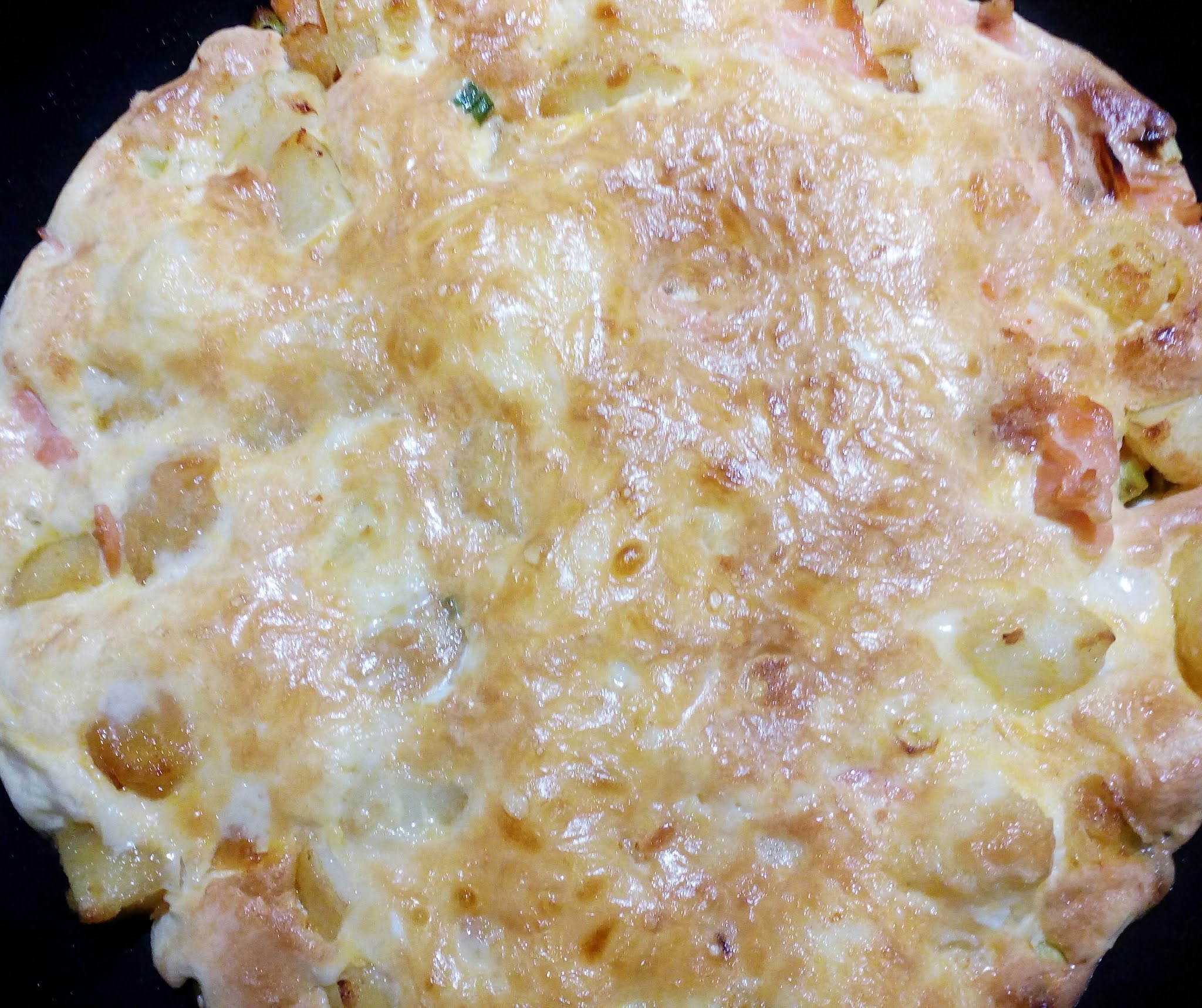
Frittata photos and bits and pieces


leftover roasties – too good to waste

the frittata from the grill


a generous slice


Quick, easy and delicious. It is perfect on its own as a breakfast treat – if you prefer a brunch you could serve with, as I did, coleslaw – because I love it. You could serve wedges on the side or beetroot relish would definitely work well too.

More bits and pieces …


Another weekend breakfast treat …

 or brunch if you prefer, with add-ons – a frittata hits the spot.

My next suggest is a combination of leftovers, staples and a treat.

I had leftover roasties – never wasted! I had the usual suspects – eggs and mature Cheddar cheese and a bunch of spring onions. The treat – smoked salmon.

Smoked Salmon Frittata

Serves 4

You'll need a large frying pan

240g roasties, cut into small pieces – plus

any crispy bits too!

1 bunch of spring onions, finely chopped

3 large eggs, beaten

2 handfuls of grated mature Cheddar cheese -

as a guide a handful weighs 75g approximately

100g packet of smoked salmon, snipped into

small pieces

a drop of rapeseed oil

black pepper

Heat a drop of rapeseed oil in your frying pan. Add the roasties and the spring onions and sauté for 3-4 minutes. Add the snipped pieces of smoked salmon and fold into the roasties and onions, sauté for 2 minutes.

Pre-heat your grill – BEFORE YOU TURN IT ON

ENSURE THAT THE FRYING PAN YOU'RE USING

WILL SLIDE EASILY INTO THE SPACE LEAVING AT

LEAST TWO INCHES GAP BETWEEN THE PAN AND

THE GRILL ITSELF, OTHERWISE YOU'LL BURN

THE TOP AND THE MIDDLE WON'T BE COOKED

Add the grated cheese to the beaten eggs to the roasties, onions and smoked salmon and cook on a medium heat on the hob for 2/3 minutes. Transfer the pan to the grill - cook for 2/3 minutes Remove the pan from the grill - USING OVEN GLOVES.

Using a fish slice gently flatten down the frittata so that you break the top – you'll find that the egg mixture is still not quite cooked. Place back under the grill for another 2/3 minutes and check – it should be golden brown but if your preference is for a darker colour carry on to your desired taste.

Serve on warmed plates – photos and bits and pieces to follow!

Saturday, 31 October 2020

Scone stack photos!

Not too shabby – assembled


There's nothing like a perfectly poached

egg


A side view showing the depth of the scone

Last but by no means least is the mornay sauce element – it's really easy and freezes too.

Mornay Sauce

Serves 4-6


40g unsalted butter

40g plain flour

600ml of milk – I use semi skimmed

150g mature Cheddar cheese

(or a combination of Cheddar and gruyere)

salt and black pepper

½ tsp Dijon mustard - optional

Melt the butter in a pan and stir in the flour. Cook gently for a minute, stirring – make sure you don't brown the mixture. Gradually add the milk whisking constantly and eventually bring to the boil, whisking until it's smooth and thick. Lower the heat and simmer for 2 minutes, then add the cheese, mustard and season. I'd taste before you add salt – there's salt in the cheese – adjust accordingly.

It's not compulsory to make 4-6 servings of the mornay sauce, halve the recipe if you prefer – personally I don't see the point of going to the bother of making a good sauce when you can freeze what you don't need for another day. A mornay sauce has many uses – it's perfect with smoked fish and hard boiled eggs – sounds a little odd but it works!

Next up, another weekend breakfast idea.


Who loves a benedict?

You know what I mean, an English muffin split, toasted and topped traditionally with ham or bacon, a poached egg and Hollandaise sauce.

These days there are many variations to suit everyone so here's my take, from the bottom upwards and since it isn't a benedict it needs a name of its own – a scone stack seems appropriate.

Instead of using an English muffin use a buttermilk cheese scone, sliced in half, warmed and buttered. Add a generous slice of smoked salmon, followed by a poached egg, complete with a generous drizzle of mornay sauce and garnish with finely chopped spring onion.

You don't have to struggle with poached eggs if they scare the pants off you – have scrambled instead.

You don't have to struggle with a classic Hollandaise sauce if it too scares the pants off you – make a mornay sauce instead – far easier and, in my opinion, much tastier. A mornay sauce freezes well and all that's required is defrosting and then warming through on the hob – not in a microwave – avoids any possibility of splitting.

Already you have two elements of the dish in the freezer – the scones and the sauce. You can freeze smoked salmon too!

Back to the scone and the English muffin and a little help. The average size of a muffin is 3-4” (8cms/10cms) diameter x 1” (2.5cms) high.

The test batch of scones I made measured 2½“ (6.5cms) x 1½” (4cms) high. Here's an idea – you could make a batch using a larger, straight sided cutter and thus make bigger scones – up the size of the cutter to 3” (8cms) approx, so as to create a more substantial portion. There's no need to waste the test batch – just serve two halves, two slices of salmon, two poached eggs or scrambled.

Here's a tip – if the tops of your scones are uneven, slice the uneven top so that it'll sit flat.

Scone stack photos coming next!


Buttermilk cheese scones … what to expect and what next

As you'd expect I made a batch – there has to be a test run!

Here's a couple of photos :


on the tray, just out of the oven


in all their glory – I'm sorry you can't

inhale the aroma!

Now we've got the buttermilk cheese scones or “biscuits” we've got the base for the weekend breakfast or brunch.

Hold that thought!


Breakfast scones – aka biscuits!

You won't be surprised to learn that my weekend breakfast treat involves a scone and more specifically a buttermilk cheese scone, here's the recipe :

Buttermilk Cheese Scones

500g plain flour

1 tsp salt

2 tsp bicarbonate of soda

2 tsp cream of tartar

2 tsps mustard powder

50g unsalted butter cut into small cubes

25g Trex broken up into small pieces -

it's already soft

160g Mature Cheddar Cheese, grated

2 tbsp Parmesan cheese, finely grated

(1 tbsp = 15g)

300ml buttermilk

1 egg, beaten for wash

You'll need two baking sheets – 30x30cms (12x12”). I sprinkle the trays with a little flour, it stops the scones from sticking.

Pre-heat your oven 200fan/220c/Gas 7.

Place your dry ingredients in a large mixing bowl. Flour, salt, bicarb, and cream of tartar. Add the butter and Trex to the dry ingredients and rub in, using your fingertips. Add the Cheddar cheese and mix. Add the buttermilk and bring together using a round bladed knife. Then use your hands and bring together to form a dough.

Flour your work surface and shape the dough so that it is roughly 4cm/1½” thick. Use a fluted cutter measuring 6cms/2¼” and place on the trays. Egg wash the scones and sprinkle the tops with the Parmesan cheese.

Bake for 12 minutes, transfer to a wire rack to cool.

They freeze very well.

Thought you might like a photo or two!


Saturday, 24 October 2020

Autumn comfort food and another weekend treat

Do you treat yourself and eat a different style of breakfast on a weekend or do you prefer brunch late morning? Everyone has their favourite guilty pleasure whether it's a simple bacon butty or the Full English. My personal favourite is large roasted Portobello mushroom on a small soft breakfast bap, not forgetting the HP Sauce!

Anyway, moving on I thought I'd suggest something completely different but first a puzzle … when is a biscuit not a biscuit? Answer … when it's a scone!

To explain – in the USA what we call a biscuit they call a cookie and what they call a biscuit we call a scone. They are generally savoury, i.e. without sugar and usually made with buttermilk.

Famously there's “biscuits & gravy”. As so often is the case a lot of dishes or elements thereof are born out of lack of ingredients and using what was plentiful and, more to the point, cheap. The “biscuit” is described as soft and doughy and the “gravy” usually made with dripping from pork sausages adding flour and milk and then seasoning. Other cheaper cuts of meat would also be used.

Here's a snippet of background.

Biscuits and gravy” is very popular in the Southern States i.e. North and South Carolina (but not exclusively). I mention the Carolinas only because I've spent time there and so can back up my mouth! It became a regional dish after the American Revolutionary War of 1775-1783.

Have you ever noticed how history repeats itself? Not that long ago I wrote at length about Cornish Pasties - this iconic delicacy evolved from humble and cheap beginnings to feed hungry tin miners who were underground for many hours. It's the same principle with biscuits and gravy – substitute tin mine with a day working on a plantation.

You probably won't be surprised to learn that there's a restaurant chain called Biscuitville in North Carolina and Virginia specialising in breakfast food and Southern cuisine.

What follows is my take on a “biscuit” - aka scone - as a breakfast choice and what to put with it!