Showing posts with label Kiddies. Show all posts

Saturday, 25 April 2020

Chicken nuggets … a step by step guide


Before we begin, the same tip as always – set your stall out, get all your ingredients ready – if you're organised it'll be fun :

Step 1 :

Pat the chicken dry with kitchen roll. Place a sheet of cling film on your board. You can place the chicken breast whole and cut afterwards or cut into small nugget sized pieces before you begin bashing – bear in mind that the chicken is to be flattened and will therefore be larger than the cut piece. Try and keep the nuggets a similar size. Arrange on the cling film making sure you leave sufficient space between the nuggets. Cover with another sheet of cling film and bash with a kitchen mallet (or rolling pin) to flatten. Set aside.

Step 2 :

Place the flour, egg and breadcrumbs in the foil trays.

Step 3 :

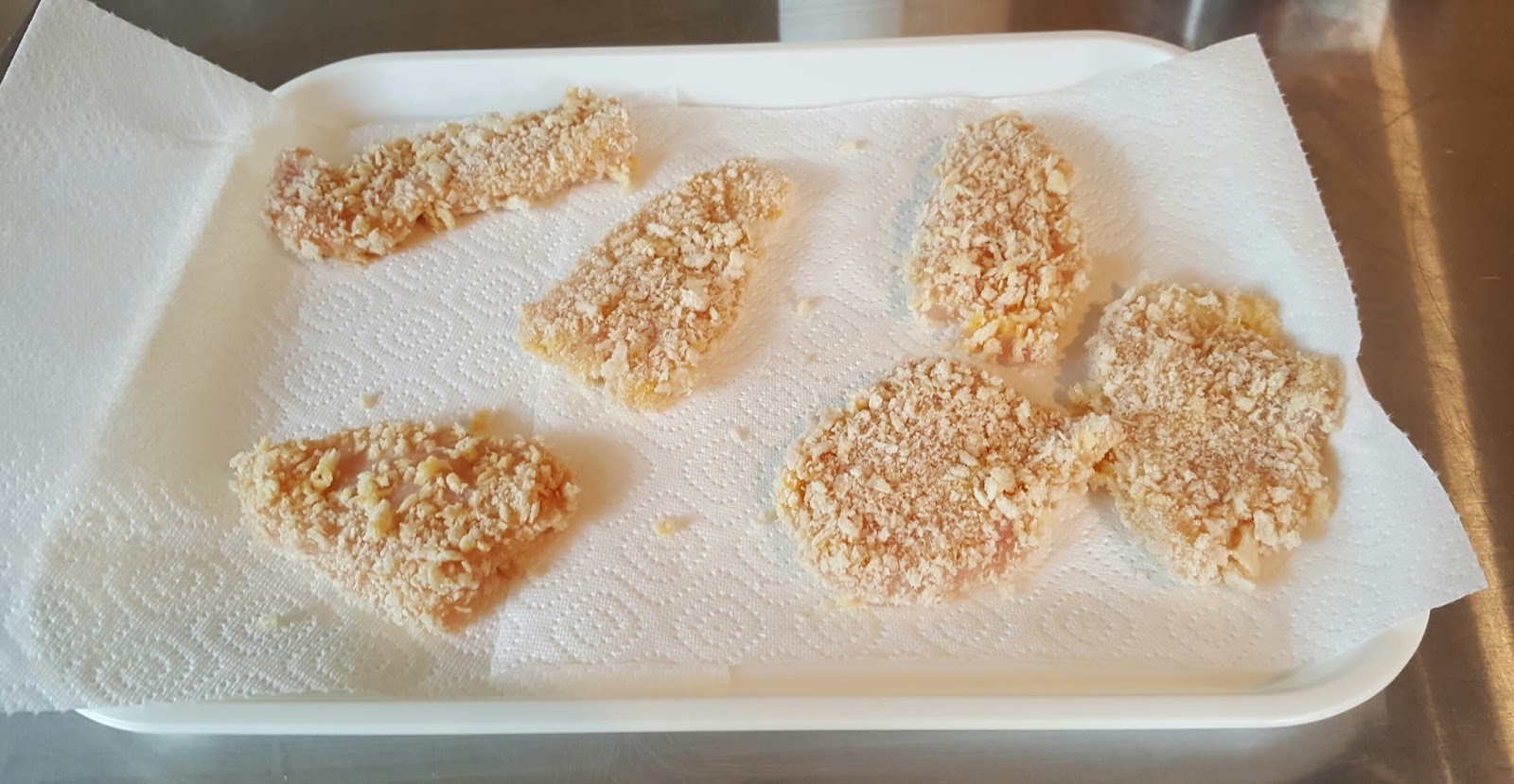
A tip before you begin – make sure you have a baking tray lined with kitchen roll ready to receive your breaded nuggets.

Now for the production line and another tip - wear gloves!

Step 4 :

Coat each piece in flour, then coat in beaten egg and finally in breadcrumbs.

If you are cooking the nuggets later, cover with more kitchen roll and then double cling film and “fridge” until required.

When ready to serve you have two options :

Pre-heat oven 180fan/200c/Gas 6.

Heat a glug of rapeseed oil in a large frying pan on a moderate heat. If you wish to check whether the oil is ready to use drop a breadcrumb into the oil – if it sizzles and begins to colour you're ready to roll. Seal the nuggets on both sides and transfer them to a baking sheet and bake in the oven for 15 minutes or you can continue on the hob – turn the heat down low and turn the nuggets frequently until cooked through and golden brown. This will not take more than 15 minutes since the chicken is bashed thinly. If you want to be certain take one and cut it in half, it should be thoroughly cooked before serving.

As a guide you should get 4-6 nuggets per breast depending on how large you want your nuggets – it's not an exact science.

Coming up – other alternatives!


Are the kids fed up yet ...


are they suffering from fast food withdrawal?

Staying with the “time on your hands” mantra and may be even answering both of the above, here's a weekend treat for the kids – big and little alike and they can help too!

One of their favourite fast food choices has to be chicken nuggets, here's my version :

Chicken Nuggets
but not as you know them

4 chicken breasts (weight 500/600kg)
Cling film
Kitchen mallet or other suitable implement
for bashing i.e. rolling pin
3 x foil trays
kitchen roll
2 tbsp plain flour
1 egg, beaten
4 tbsp/100g breadcrumbs

You can use ordinary breadcrumbs or use Panko
crumbs if you can get them – they are larger – blitz
them for a finer texture


A “double whammy” - getting the kids involved and supper ready too!

Next - a step by step guide and some “variations on a theme” of the chicken nugget.

Sunday, 14 April 2019

Rubble – the plus points and the bonus


White chocolate is popular with the kids – it's not for the chocolate purists but, in this instance if you want to encourage the kids to eat fruit and nuts, it works.

I describe this treat as a sort of tutti frutti – by that I mean the Italian ice cream but using chocolate instead - not the bagged confectionery. Another useless piece of information – tutti-frutti means “all fruits”. Tutti-frutti has morphed into all sorts of different variations, depending which country you're in.

Another plus is only 40% of the treat is chocolate, the remaining 60% is fruit and nuts.

I would definitely recommend toasting the chopped pecans with the sea salt flakes, white chocolate is sweet and the slight saltiness of the toasted pecans helps balance that sweetness.

Cut into cubes, you'll get 96 pieces from your batch!

Given the success of the Rocky Road I have discovered that personal is special. Pretty bags or boxes are inexpensive – check out the cheaper High Street shops – the Rubble cubes fit into the eggs for the hunt – just like this :


Step by step photo guide is up next.


Saturday, 27 August 2016

Hooked on cooking – Jess makes a Tower

It would be rude not to offer Grandad a dessert so here's The Tiramisu Tower, based on the Orange Tiramisu mentioned previously. This time it's the lemon version using our now famous smoothie cups.

Lemon Tiramisu

Lemon syrup
(4 tbsp lemon juice, 100g icing sugar)
20 fl oz whipping cream
Madeira cake
4 tbsp caster sugar
8oz Mascarpone
Lemon curd to fold into Mascarpone mixture

To make the syrup put the lemon juice and the icing sugar into a small saucepan and heat gently so that the sugar dissolves. Set aside to cool. Decant the syrup into a squeezy bottle.

Mix the cream carefully with the caster sugar and mascarpone, gently fold lemon curd through the mixture.


Cheflet's privilege!

Slice the cake lengthways as thinly as possible and then using cutters, cut into shapes that fit the smoothie cups.


Layer the cake shapes in the cups and drizzle with syrup, then add a layer of the mascarpone mixture, repeat. Decorate the top of the tiramisu with a circle of Maltesers and place a wafer roll through the hole in the lid of the cup.

Here's the masterpiece :


Grandad's verdict – delicious!


Hooked on cooking – Supper for Jess and Grandad too!

When ready to serve you have two options.

Pre-heat oven 180fan/200c/Gas 6.

Heat a glug of rapeseed oil in a large frying pan on a moderate heat. If you wish to check whether the oil is ready to use drop a breadcrumb into the oil – if it sizzles and begins to colour you're ready to roll. Seal the nuggets on both sides and transfer them to a baking sheet and bake in the oven for 15 minutes or you can continue on the hob – turn the heat down low and turn the nuggets frequently until cooked through and golden brown. This will not take more than 15 minutes since the chicken is bashed thinly. If you want to be certain take one and cut it in half, it should be thoroughly cooked before serving.

As a guide from the three chicken breasts Jess made 8 decent sized nuggets and 1 whole breast for Grandad, prepared in exactly the same way as the nuggets. Grandad's version is called an escalope and is traditionally veal.

Here's the breaded nuggets :


Here's the end product :


Jess learnt the French culinary technique panĂ© – meaning coated with breadcrumbs.

Don't you love it when a plan comes together!


Hooked on cooking – Here's my Cheflet!

It's about time I gave you photographic proof of what I've been droning on about for the last few weeks. Here's my Granddaughter, Jess.


Never let it be said I don't do the research – my question to Jess was what was her favourite fast food choice – easy – chicken nuggets, so, here they are :

Chicken Nuggets
but not as you know them

3 plump chicken breasts (weight 500/600kg)
Cling film
Kitchen mallet or other suitable implement
for bashing i.e. rolling pin
3 x foil trays
2 tbsp plain flour
1 egg, beaten
2 tbsp breadcrumbs plus an additional 2 tbsp
to top up

Step 1 :

Pat the chicken dry with kitchen roll. Place a sheet of cling film on your board. You can place the chicken breast whole and cut afterwards or cut into small nugget sized pieces before you begin bashing – bear in mind that the chicken is to be flattened and will therefore be larger than the cut piece. Arrange on the cling film making sure you leave sufficient space between the nuggets. Cover with another sheet of cling film and bash with a kitchen mallet (or rolling pin) to flatten. Set aside.

Step 2 :

Place the flour, egg and breadcrumbs in the foil trays.


Step 3 :

Now for the production line. Jess wanted to wear gloves – sadly I didn't have a pair small enough but hey she managed for a little while. A note before you begin – make sure you have a tray lined with kitchen roll ready to receive your breaded nuggets.


Step 4 :

Coat each piece in flour, then coat in beaten egg and finally in breadcrumbs.

If you are cooking the nuggets later, cover with more kitchen roll and then double cling film and “fridge” until required.

to be continued!


Saturday, 20 August 2016

Hooked on cooking – Dessert design - The Tiramisu Tower

This Tiramisu Tower is perfect for the cheflets to show off their new found talents – for themselves as a treat or, if you are still in entertaining mode, let them create individual Towers for the guests. If you are dining al fresco then your picnic plastic is perfect or, if indoors you could always use glass tumblers for the grown-ups.

Here's the basic recipe :

Orange Tiramisu
(Serves 4/5 depending on size of dessert bowl)

Grated rind and juice of 2 oranges plus
4 additional tbsps of orange juice
20fl oz whipping cream
Madeira cake – 2 x 250g(ish) – you may
not use it all but it won't go to waste
4tbls caster sugar
8oz Mascarpone or Philadelphia
2oz plain chocolate (grated)
or chocolate flakes, bashed in their packets
circular cutters – various sizes


Mix the orange rind and juice.

Mix the cream carefully with the sugar and mascarpone. **see below.

Cut up the cake in shapes that suit the bowl you are using and dip into the orange mixture.

Grate the chocolate

Layer the mascarpone mixture with the sponge and sprinkle with chocolate.

Variations

I'm suggesting an orange syrup as an optional extra. Ideally it should really be made ahead so it can cool properly and become gloopy – in case you're not aware this is a technical cookery term! It needs to be perfect to fold gently through the mascarpone and sugar, creating a brilliant orange stripe through the mixture and a final drizzle over the top of the tower before sprinkling with chocolate**.

Any remaining syrup can be served in a jug (if eating inside) or a squeezy bottle (if eating al fresco)

If you are making double the quantity of this dessert I'd suggest doubling the amount of syrup.

Orange Syrup

200g icing sugar
250ml orange juice (no bits)

Put the sugar and orange juice in a small saucepan and heat gently so that the sugar dissolves. Bring to the boil and then reduce the heat and simmer on a low heat for 10 minutes.

You could if you wish add an additional layer of oranges or mandarin oranges. You can buy easy peel oranges (the size of a large satsuma) if you'd like to use fresh fruit or, if not available you can buy tins of mandarin oranges in fruit juice. If you used tinned mandarins then you could use the fruit juice in the orange rind and juice dipping mixture – waste not want not!

I appreciate not part of a classical tiramisu but it adds an extra level of fruit and hey – as I've always said, rules are made to be broken.

My final suggestion is that you might want to check out your favourite cut price shop and buy some long handled sundae spoons – ideal to reach the bottom of tall glasses – plastic or otherwise!


Hooked on cooking – Dessert design - a vertical split

 … with a twist

Sorry, couldn't resist an Olympics idea – this sounds like some sort of fancy dive with a degree of difficulty to make your eyes water.

Instant dessert or may be a treat for the cheflets to assemble themselves, this is a variation of a banana split but built vertically in your trusted picnic plastic – the smoothie cups would be ideal.

For 4 cheflets

4 bananas – peeled and sliced when
ready to assemble
4 scoops of vanilla ice cream
4 tbsp of chocolate sauce (see below)
2 tbsp of flaked almonds or chopped
pistachios
glacé cherries to decorate

Sticky Toffee Sauce

4oz unsalted butter
8oz soft brown sugar
10 fl oz double cream (or whipping cream)

Heat together the butter and sugar. When dissolved add the cream.

Simmer for 15 minutes, stirring.

When cooled decant into two squeezy bottles – 1 per 2 cheflets.

Squeeze a blob of sticky toffee sauce into the base of your Smoothie Cup or other picnic plastic of choice.

You have options with regard to your chocolate sauce. You can cheat and buy it but if you'd like the cheflets to have a go, make some ganache. You can make ganache to suit your recipe, see below. I would opt for the option underlined to create a more sundae effect in the cup but it is purely a matter of taste.

On that basis heat 250ml of double cream on a medium heat, bring just to the boil and then pour over 250g of dark chocolate chips – minimum 50% cocoa solids - whisk until smooth. Allow to cool. If you are not using chocolate chips, then chop your chocolate as finely as possible.


Ganache

There are 3 options :

Equal parts chocolate and cream. While still warm this ganache is pourable and can be used to drizzle chocolate ribbons or glaze cookies or cakes. It can also be used as a cake filling. As it starts to cool it thickens and takes on a more spreadable consistency.

Two parts chocolate to one part cream.

Increasing the percentage of chocolate makes for a thicker ganache. This ratio is used for truffles. Can also be used as a glaze or piped frosting.

Two parts cream to one part chocolate.

A ganache with more cream than chocolate is runny – warm and mousse like at room temp. When warm it can be poured over a cake to give a glaze.

The ganache and the sticky toffee sauce are easy elements with some supervision and could be done at the hob together i.e. 2 cheflets making the ganache and 2 the sticky toffee sauce.

You can use a shop bought vanilla ice cream or get the cheflets to make a batch ahead of the game from the recipe on the blog.

The cheflets can now build their vertical split, sticky toffee sauce, layer of bananas, blob of ice cream, large blob of ganache, repeat and finish off with a theatrical drizzle of sticky toffee sauce and chopped nuts.

I hope the idea of a vertical banana split might amuse - you can add anything you like, the cheflets are making a ganache and a sticky toffee sauce, not to mention the vanilla ice cream if so inclined!

The split should be decorated with a glacĂ© cherry – do not forget the cherry!

Saturday, 13 August 2016

Hooked on cooking – Dessert design… a blank canvas

The model shown measures 50x38 cms. The cake boards mentioned measure 25x25 cms for the square and 25cms in diameter for the circular.

What to do with the blank canvas – that's up to the cheflets. Here's a photo with a few bits and pieces :


The additions speak for themselves – the pile of logs are wafer rolls - the muddy puddle in the centre of the logs is the caramel glue. You could if you wished melt chocolate as an alternative. The flowers – I use the term loosely – are meringue kisses with a hole in the bottom – punched through gently with a cocktail stick and a chocolate mint stick cut in half inserted for the stalk/stem. The pink versions are mini raspberry macaroons.

In other words, fill all the remaining space on the boards and in between, directly on to your table cloth.

The list of what can be added is huge but here's a few ideas :

Fresh fruit – strawberries, cubes of fresh pineapple,
ditto of mango – convenient to dip into muddy puddles

any other fresh fruit of your choice

cubes of Madeira cake or lemon drizzle

meringue nests filled with blueberries and raspberries

Remember the squeezy bottles mentioned – you could make up one each of lemon drizzle syrup, orange syrup, sticky toffee sauce and strawberry coulis.

I mentioned in the original shopping list that you might like to include the ingredients for Rocky Road and Malteser cake. Have a look at the photos of each below and I hope you'll agree that either or both of these scattered creatively of course, would make a great addition.

The recipes for all of the above are on the blog.


Note:

If you decide you'd like to give the cheflets either or both of these then they'll need to be made ahead but neither are difficult or time consuming.

Now for the good news – when your party is over any leftovers can be boxed, fold up the table cloth and bin – Marigolds (aka washing up gloves) not required!

Ta Dah!

Just before I go, a big thank you to my mate Susie Q who helped me translate the idea in my head to the model – mwah.


Hooked on cooking – Dessert design… follow the yellow brick road!

Your road needs to be neat and to show definition so we need to create an edge of stones. Enter the mini marshmallow and the best glue ever – I give you “Carnation cook with caramel” (in other words condensed milk with added caramel) I've not seen it in smaller cans than 397g but it's not as expensive as buying a jar of posh caramel sauce – it makes great glue.

Now you know what the paintbrushes are for – one for each of your cheflets and in order to prevent any dispute it might be more practical to give each of them a small dish of caramel. You'll be able to pick up the brushes in your preferred “£1” shop.

Using the “glue” paint a line either side of the road. The marshmallows can then be glued into place. It matters not if the glue strays further on to the board - so not a problem for small hands – it will be covered soon enough with grass and soil!

You can buy bags of pink and white mini marshmallows so you could add more colour by alternating pink and white edging.

The story so far, a board each with a piece of road with edging stones and a bag of desiccated coconut grass.

The next step is for the cheflets to create the soil. Each should have a chocolate muffin and a plastic food bag. Place the muffin in the bag, secure the top and crumble into soil.

Back to the paintbrush - paint either side of the road with the glue – again it doesn't matter if they stray onto the cloth with the glue or grass or soil but they do need to bear in mind that their board should stay in its place.

Your cheflets can now scatter their coconut grass and muffin soil where they may on their respective boards.


Hooked on cooking – Dessert design… choose a theme

It can be anything the cheflets like – they may need inspiration – a word of warning though, it shouldn't be too ambitious – it needs to succeed.

To explain myself the example I've chosen is The Yellow Brick Road from The Wizard of Oz.

The road shown is made from marzipan, rolled quite thinly. The beauty of using marzipan is that if you do make a mess of it you just roll it into a ball and begin again. A small tip – a dusting of icing sugar on your surface will help. Give each cheflet a cake board together with a quarter of the block of marzipan and a rolling pin – their road should be rolled directly onto the cake board. They could reproduce the road shown or they could make a crazy paving, using circles made with cutters of different sizes. The road doesn't have to be straight, there are no rules.


When each portion of road is completed the boards should be placed on the paper table cloth, wherever they like. My only suggestion is that each board has roughly the same amount of space surrounding it.

The cheflets next job is to weigh 25g of desiccated coconut into a ziplok bag – squeeze a large blob of green food colouring into the coconut, carefully expel the air and seal the bag. Work the colouring into the coconut – this will take a minute or two, rubbing the bag between your hands – the coconut absorbs the colouring and the more you work it the more even a colour will result.


The table cloth on your shopping list IS the base for the dessert – no bowls, no plates – fingers only but, you might want to make sure you've plenty of serviettes/napkins or, if you must, then spoons or forks – it defeats the object of sticky fingers and I can testify that when I did do this, the grown-ups loved it too.


Friday, 29 July 2016

Hooked on cooking – picnic plastic!

A little imagination goes a long way – especially when it doesn't cost lots of dosh. Have a mooch around your cheap and cheerful stores – method in the madness – receptacles that don't cost the earth but make excellent containers for building trifles or whatever you'd like to call them. I give you my latest find, Smoothie Cups with lids – 8 per pack – cost £1.


If you don't want lids then you can get packs of half pint and pint measures for the same price.

You could introduce a touch of competition and if you are “supervising” a group of say 4, then get someone else to judge the best and give a small prize – in the interests of impartiality, it shouldn't be you!

You don't have to spend dosh at all if you have a stash of empty jam jars – clean of course. Safety may be an issue depending on the ages of your students.

There's a huge selection of all sorts of picnic plastic out there, especially if your intention is to save on washing up – which, by the way, is the responsibility of your students – not the Supervisor!


Saturday, 23 July 2016

Lets make afters

My first “afters” offering in “get them hooked on cooking” is Pinwheels. Once again minimum work in the way of prep for the supervisor, only a few minutes and the night before works well for me! No stress and maximum fun for the budding chefs.

Pinwheels

1 sheet of frozen puff pastry, thawed in fridge (375g)
15g butter, melted
50g dark chocolate drops (or finely chopped)
25g ground almonds
25g dried cherries, finely chopped
25g craisins, finely chopped
1 egg, lightly beaten with 1 tbsp milk

Preheat your oven 180c fan/200c/Gas 6. Line a baking tray with greaseproof paper or similar. Unroll the pastry sheet and lay with the short sides left and right, you are going to roll to form a log.

Brush the surface of the pastry and melted butter then scatter the chocolate and ground almonds leaving a border at the top end of the pastry to enable you to “glue” the log when rolled. Then scatter the cherries and craisins over the chocolate and almonds. Carefully roll up from one of the shortest sides as tightly as you can forming a log.

Using a sharp knife, cut the log into 12 even slices. Place on the baking tray and brush with the remaining butter, then the beaten egg mixture. Bake for 15-20 minutes until puffed and golden.

Fondant Glaze

75g icing sugar
2-3 tsps boiling water

Pour the boiling water slowly over the icing sugar in a small bowl while stirring the mixture with a wooden spoon. Pour in only enough water to make a creamy mixture that has the consistency of pancake batter. Cool. You need to make sure the mixture isn't too stiff, you need to be able to drizzle the glaze over your pastries.

Here's some helpful illustrations and the end result.


Take a tip or three :

Use the greaseproof wrapping with the pastry sheet as a base to roll the pinwheels.

Place a damp j cloth on your worktop and then the sheet on top – it will avoid it ending up on the floor!

When you get to the stage of slicing into 12 portions mark the roll in the middle, and then each half again (i.e. quarters) and then divide each quarter into 3 – there's a fighting chance of reasonably even pinwheels.

I warn you – these will vanish at the speed of light – it's a good idea to have two batches 1 x 2 kids.

Lets make lunch

If you've ever had to cope with grumpy teenagers then a crucial ingredient in the “hook” is speed – not for nothing do we call it “fast food”.

In this spirit, first up is the Stromboli previously mentioned in the blog. In my opinion it cannot fail – it suits young and old alike – if you're overwhelmed by the size of a whole pizza Stromboli does away with this problem because you can help yourself to as many small slices as you wish.

In your “supervisory” prep ahead you might like to think about providing a range of toppings so that the kids can choose whatever they want to fill their stromboli. For example, ham, pineapple, chicken, sweetcorn, olives, salami, pepperoni, mushroom, peppers, onions, greenery of your choice i.e. baby spinach, blah blah! You get the picture – you know best the likes and dislikes of your charges.

Here's the recipe again for ease of reference :

Stromboli


400g prepared pizza dough or ready-made base
4 tbsp tomato paste
100g thinly sliced salami
120g baby spinach
100g thinly sliced mozzarella cheese
1 tbsp olive oil
Generous sprinkle of oregano or garlic Italian seasoning


Pre-heat your oven 220fan/200c/Gas 8. Place a large baking tray in the oven.

Place a dampened J cloth on your work surface. Place a piece of baking parchment on top of the cloth – it will stop it sliding – make sure you leave enough to get hold of – you're going to lift it onto the hot baking tray that's in the oven at the moment. Unroll the pizza dough gently on the parchment.

Spread the tomato paste onto the base. Add the slices of salami, followed by the spinach and then the mozzarella and sprinkle with the oregano or garlic Italian seasoning. Roll up the base from the shortest side and brush with the olive oil - make sure it's seam-side down when placed on the tray.

WITH CARE remove the tray from the oven and then carefully lift the parchment and the rolled up pizza onto it. Place back in the oven for 20/25 minutes until golden brown – check at 20 minutes.

When removed from the oven slice into portions to suit and serve.

Choose any of your favourite pizza toppings to create your own Stromboli – the fastest pizza ever.

Asda for the prepared pizza dough - £1.30 per 400g pack.

If you want to know what it looks like, check out Salad revival Italian style: Stromboli for the salad.


When an unstoppable force...

... meets an immovable object

In this instance the immoveable object I'm talking about is a younger person (and it varies in age) who doesn't consider it cool to cook!

I think it matters therefore what you choose for the first session – you need to get their attention and pizza is not a bad place to begin. Just in case there are doubters out there saying - “junk food”. I concede that there are elements that may be considered junk but it's being assembled with fresh ingredients as you'll see.

If your children have friends who are interested and you can manage 4 it creates a great atmosphere and they get so interested in what they are doing they forget to fall out or squabble! If you have sufficient space and a friend to perch with you and help supervise then the more the merrier but 4 would be a good place to start. It also gives you two groups of two – plenty of food for everyone to share.

A word to the wise - I'd like to suggest that if you're going to try “hooked on cooking” during the holidays you might deliberately cook more protein than you need over a weekend. It doesn't really matter what sort – chicken, lamb, beef - all will be revealed.

A little prep goes a long way – ingredients you'll need won't be difficult, unusual or expensive.

Any kitchen kit required really depends on the ages of the kids – you can buy wooden spoons, rolling pins et al for small hands quite easily these days and inexpensively too.

Knives however are a different kettle of fish and you may be surprised to know that there are knives specifically designed for childrens' use when learning to cook. Check out “Kiddi Kutter Childs Safety Knife” www.lakeland.co.uk. This product is suitable for age 3+.

Lets get on.

Have some fun …

with the kids and get them hooked on cooking!

Whether you're a parent or grandparent you can't avoid the fact that it's that time again – aargh – the school holidays. It may be that as a parent you are taking time off, shortening your working days or are fortunate enough to have parents to call upon to help with care.

If you are responsible for child care then I take it that under normal circumstances – budget permitting, you may send the children to a holiday club or something similar. If not this route then may be a day out here and there.

Whatever the circumstances, how about getting the kids hooked on cooking. I'm not talking Michelin Stars here but we all have to start somewhere and, if you get them interested now, think how much money they'll save when they go off to University – or wherever life may take them – if they can cook for themselves.

Picture yourself perched on a kitchen stool supervising (with your coffee or tea) - not only are the kids learning, they are preparing their own lunch and yours too - which they'll take great pride in serving – believe me when I tell you this!

Depending on the ages of the children then obviously the amount of supervision required varies.

This summer – even if it's only a couple of days a week – why not let the kids make their own lunch and supper too, each with a dessert and on different days to avoid boredom - who knows – it just might catch on.

So be prepared to let them get down and messy.

Sit back and watch the fun and think of the money you'll save too!

Saturday, 27 February 2016

Easter & the egg - The Barks

There are two versions mentioned here – the first I've used on many occasions, it's quick and easy and looks good bagged and bowed, or arranged in a small pot.

Chocolate Bark

Handful of chopped dried cranberries, chopped dried apricots and toasted, roughly chopped hazelnuts.

Line a baking sheet with clingfilm. (Baking sheet should be approximately 30cm x 18cm) You will find the clingfilm easier to control if you oil the baking sheet.

Break 300g of dark or milk chocolate into pieces and put in a bowl over a pan of barely simmering water. Melt.

When the chocolate has melted pour it onto the clingfilmed sheet.

Scatter over the fruit and nuts. Wear a disposable glove and very gently ease the fruit and nuts into the chocolate.

Leave to set for 4 hours before breaking into chards.

You can use any combination of fruit and nuts to suit your taste – tailor the recipe to suit your favourites – it is Easter after all and you deserve a treat.

If you wanted to add an extra dimension – discover your inner Jackson Pollock – melt 100g of white chocolate and, using a fork – holding it high above the tray, drizzle the chocolate over the bark. Note to self – make sure you place kitchen roll underneath the baking sheet so that you don't cover everywhere in chocolate.

The second version is probably more to the grown-up taste :

Pistachio and tart cherry chocolate bark

400g plain chocolate, chopped
200g white chocolate, chopped
300g pistachio nuts (minus shells) toasted
200g dried tart cherries

Before you begin, oil a baking sheet 30x20 cms approx and line with cling film. You have two options – you can melt the chocolate in the microwave – if you choose this method then, using a microwave-proof bowl and based on a 700w oven, the plain chocolate should take 1 minute 35 secs. The white chocolate should take 1 minute 30 secs. Ensuring that the plain chocolate is melted stir in the nuts and cherries but reserve some of each to decorate. Tip the chocolate onto the sheet and spread until it's approximately 1cm thick. Drizzle the white chocolate over the top, then, for example, use a bamboo skewer (the type you'd use for kebabs) and drag the pointed end through the white chocolate in different directions. Decorate with remaining nuts and cherries and fridge for minimum of one hour. Cut the bark into chards and bag or box, add a gift tag.

If you'd prefer to not to use a microwave then melt the chocolate by placing in a large bowl over a pan of simmering water. The downside to this method is that you're creating lots of washing up since you'll have to melt the plain and the white chocolate.

The bark should be kept in the fridge until ready to devour. If you are making the bark for your own indulgence then store in a sealed container – it will keep for up to a month – in your dreams!


This recipe will give you approximately 1kg of bark – halve the quantities and use a smaller baking sheet if you don't want so much – I believe you!

Easter & the egg - The kit and the cost

Despite what I said about paying for packaging I do have a couple of inexpensive but effective ideas. Check out your “bargain” shops – these pretty boxes shown below cost 89p for a pack of 3 and each holds four Easter nests. The cases cost 49p for 60.

Here's what the kids can produce easily :


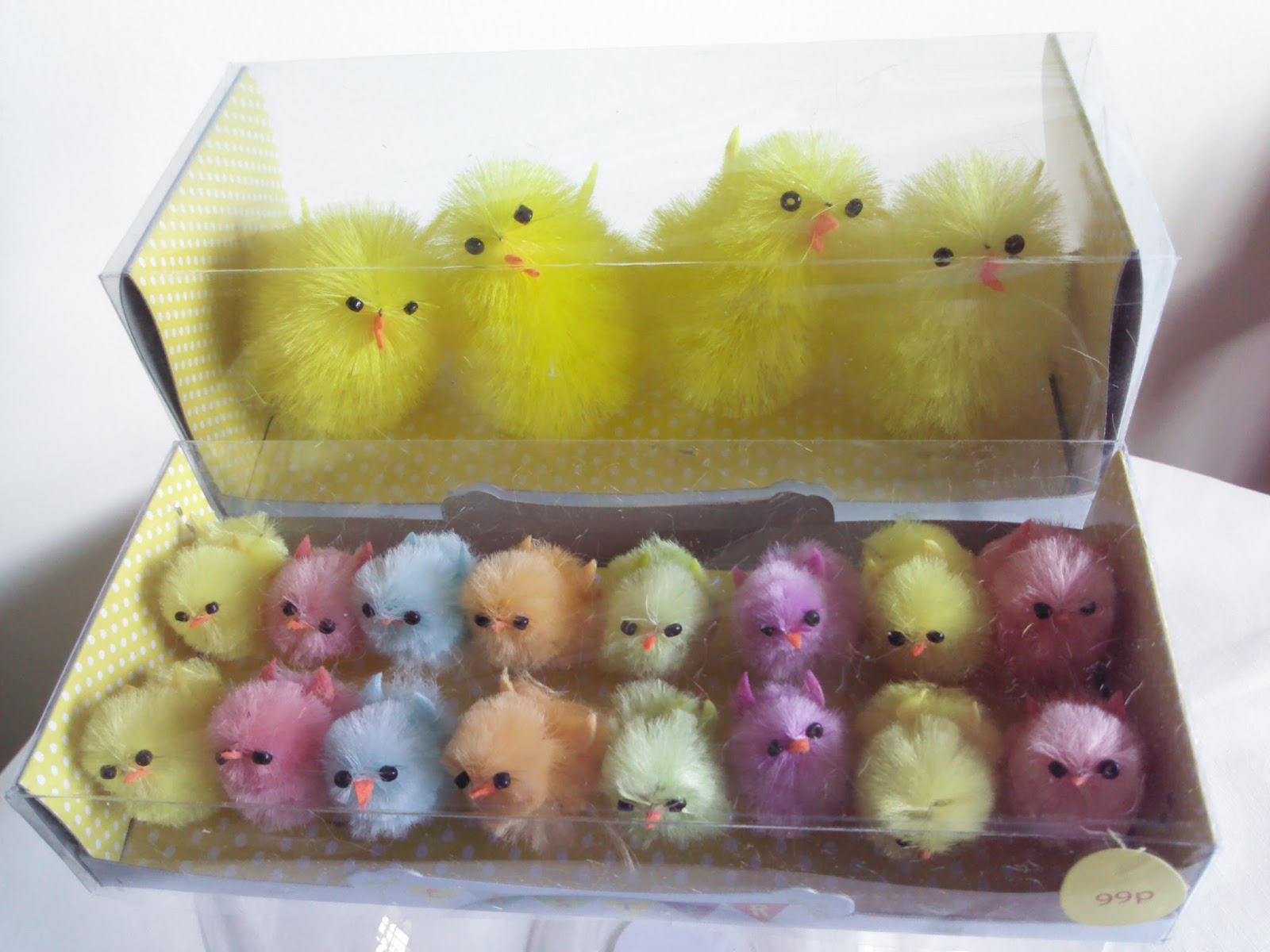
There's a whole range of stuff to choose from – here's a photo of a few bits and chicks!


The Easter chicks in various sizes are 99p per pack. The cellophane treat bags are 79p for 12.

I'm not sure who'll have the best time – the kids or the grown-ups!


Easter & the egg

… the chocolate version that is.

Now I'm not being a misery but I really object to paying for packaging and very little chocolate and for chocolate that never tastes the same as it does in “bar” form - at astronomical prices. Never has foil and card been so expensive.

I'm not sure what the “bah humbug” equivalent is for Easter but you see where I'm coming from!

So, here's a few ideas for creating your own treats – especially if you want to entertain the kids during the holidays – what about them creating their own Easter treats and gifts.

This first recipe must be 50 years old if it's a day.

Easter Nests

200g plain chocolate, broken into small pieces
30g golden syrup
50g unsalted butter
100g cornflakes
36 mini eggs – 3 per nest -
you could add more if you wish

Makes 12


Place the chocolate, syrup and butter into a bowl and melt over a pan of simmering water.

While this is melting, line a muffin tray with 12 paper cases.

Whisk the chocolate mixture together until it's smooth and shiny, then remove from the heat. Add the cornflakes and mix to coat evenly.

Portion out the mixture into nest shapes in the paper cases and put 3 mini eggs in the middle of each. Place in the fridge to set.

I made the nests using rice krispies and milk chocolate. You could mix plain and milk chocolate if you preferred - whatever takes your fancy, but I hope you'll agree the ingredients won't break the bank.

A helpful note or two about chocolate :

When melting, do so in a large bowl.

No water and/or metal in the bowl.

Do not overheat, gently does it.

Leave melting chocolate alone – resist the urge!

Ensure that the simmering water does not touch the bottom of the bowl. It should be the steam from the water that melts the chocolate.